

The state Government’s NT solar battery grant, the Home and Business Battery Scheme, has now ended after the $6 million funding cap has been met. However, that doesn’t mean that the Northern Territory has run out of solar incentives to make the cost of installing or improving a system less steep.
The Commonwealth is now providing a Federal solar battery rebate targeting storage, to make it easier to get more out of your solar PV system if you already have one; or to potentially make the decision to switch into solar more appealing.
But first,
What is the Cheaper Home Batteries Program?

Beginning July 1, 2025, the Australian Government is providing an up to 30% discount rebate on eligible small-scale solar battery installations. This is accessible for homes, landlords and businesses — however there is a limit of one per property.
- Funding of $2.3 billion for rebates nationwide.
- Batteries must be between 5kWh to 100kWh in capacity, but the rebate only applies to the first 50kWh.
- The new solar battery rebate will be delivered through the Small-scale Renewable Energy Scheme, which is the same program that produces STCs for new renewable installations.
Find out more about your Northern Territory solar rebate eligibility, ideal solar battery solution, and join Solar Battery Group’s priority queue for the National Battery Rebate Program here.
How Many STCs are Generated Based On Your Location in the NT
New solar battery installations create specific amounts of STCs based on the Zone Rating of the installation and the amount of energy storage they deliver. The STC Zone ratings brackets the amount of sunshine areas expected from highest (Zone 1) to lowest (Zone 4).
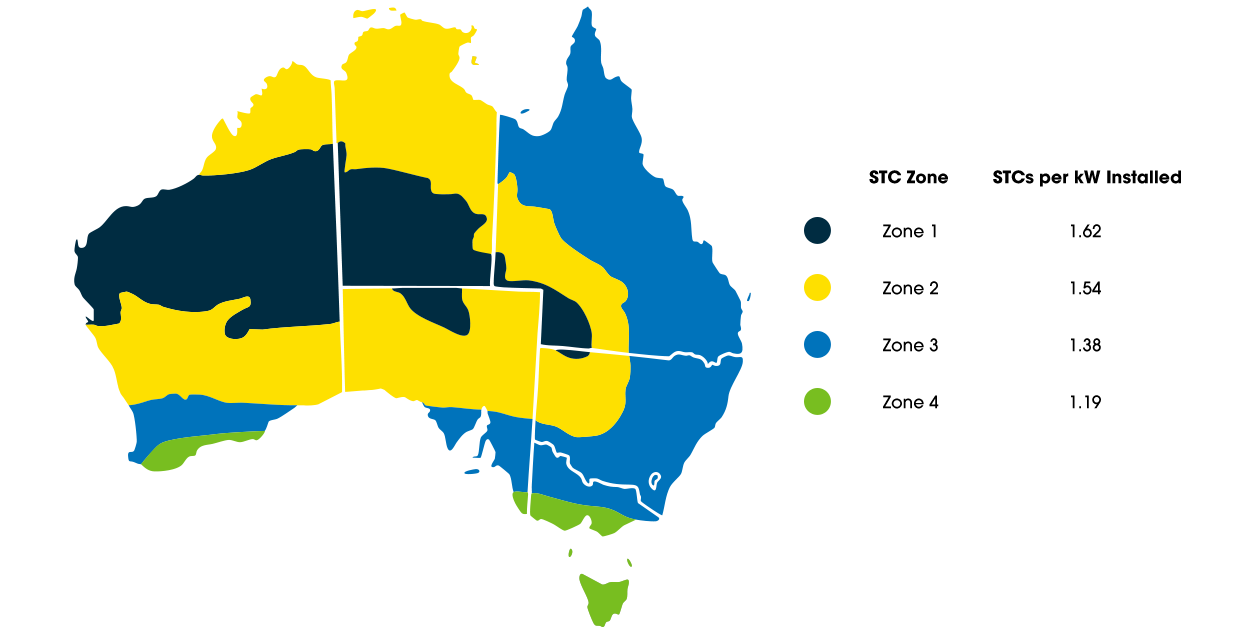
The Northern Territory is made up predominantly of areas in Zone 1 and Zone 2. Zones with the highest and the moderate expected rates of sunshine.
This means there’s plenty of sunshine for solar PV systems to generate power — and store it for later use with a battery.
How Much Sunshine is There In Your City?
Average daily Global Horizontal Irradiation (GHI):
- Darwin: 5.776kWh/m2
- Palmerston: 5.687kWh/m2
- Alice Springs: 6.219kWh/m2
- Katherine: 6.167kWh/m2
- Tennant Creek: 6.299kWh/m2
GHI is a measure of how much sunlight hits a flat surface like the ground or a rooftop. It tells us the total amount of solar energy coming from the sun, both direct rays and scattered light, that reaches the earth.
How Much Does a Solar Battery Cost in the Northern Territory (2025)?
With the highest zone ratings nationwide, you can expect to lean towards the higher end of the amount you can get back from the federal solar battery rebate.
However, costs for delivering and installing within the Northern Territory are costly, which unfortunately means the total cost you pay in addition to the unit itself is also higher.
We can provide you assistance with understanding whether the upfront cost of your investment is worth it for your situation. Request a call back and have your energy bill ready, and we can provide you with more information based on your unique circumstances.
We can even include a quote on a custom solution, so you understand how much is the cost before you make the leap.
Other Resources for NT Solar Users:
This is a $1 billion fund dedicated to providing households with green loans and other low-cost finance products to make investment into more energy efficient technology, such as solar panels and solar batteries, more accessible. Alongside the Cheaper Home Batteries Program, this fund can make it easier to invest into a new solar battery installation.
Jacana Energy is the Northern Territory government-owned electricity retailer, which is providing different rates of solar feed-in tariffs for excess solar power exported to the grid.
-
- Super feed-in tariffs: 18.66c/kWh 3pm to 9pm daily.
- Anytime feed-in tariffs: 9.33c/kWh, for hours outside 3-9pm.
Main Reasons to get a Solar Battery Installation in the Northern Territory
You live in a blackout hotspot
- Katherine
Katherine was the worst performing region in terms of energy stability in the NT across 2023-24, with customers facing an average of 6.7 interruptions and 501 minutes (over 8 hours) without supply.
- Tennant Creek
While Tennant Creeks’ energy reliability has been getting better, it has lagged behind in stability every year when compared to Darwin and Alice Springs.
Read more from the NT Utilities Commissions 2023-24 report.
You want to go off grid and gain energy independence
If you’re considering going off-grid, it’s likely because you’re seeking independence — not necessarily chasing short-term savings. And that distinction matters. In the Northern Territory, grid connections can be fragile, especially outside the main centres. But it’s important to know that true off-grid systems are complex and significantly more expensive than standard grid-connected battery setups.
- Yes, you can disconnect from the grid — but it comes with higher setup costs and the need for a carefully balanced system that includes ample storage, solar generation, and potentially a backup generator.
- No, it won’t necessarily pay for itself quickly, especially when installation and delivery costs in remote areas are factored in.
That said, if you live far from stable grid infrastructure, or simply value energy self-sufficiency, a battery-backed off-grid system offers real peace of mind — and a genuine lifestyle upgrade. It’s about control, resilience, and long-term vision, more than financial return alone.
You want to help support a more sustainable future
It’s true that solar batteries can help reduce reliance on fossil fuels — but the sustainability case for them isn’t always as clear-cut in the NT.
- The environmental benefit depends largely on how much solar you’re able to generate and store consistently. In the NT, that’s promising, thanks to abundant sunshine.
- However, the embedded emissions in battery manufacturing, transport (especially to remote regions), and the shorter usable lifespan if systems aren’t optimally sized or maintained, all play a part too.
Still, there’s value in seeing a battery system as part of a bigger picture. While you may not be joining a Virtual Power Plant (VPP) just yet — because they’re not currently active in the NT — you are laying the groundwork for when those grid-supportive services do arrive.
If your goal is to reduce your carbon footprint at home and you already have solar, a battery helps you store clean energy for night-time use, and that alone can make a meaningful, if modest, contribution to your household’s sustainability.
You want to hedge against energy bill volatility
A few years ago, it was difficult to justify a battery in the NT based on electricity bills alone. High installation costs and long payback periods (often exceeding the battery warranty) made them a tough sell financially.
But with the new federal rebate covering up to 30% of installation costs, the economics are shifting. While NT still has some of the highest per-installation battery costs in the country, the rebate helps bring it within reach — especially for those who expect power prices to keep rising.
- If you’re mainly motivated by savings, it’s essential to understand your actual energy usage, peak times, and how much solar you export. A battery won’t eliminate your bill, but it can shave off the peaks.
- If you’re aiming for cost predictability, batteries offer protection from price spikes and any feed-in tariff reductions, but only when sized correctly and used strategically.
You’re a High Electricity User
If your household or business consistently racks up high electricity bills — whether it’s from running multiple air conditioners, charging an EV, operating pumps or tools, or simply powering a busy home — a solar battery can offer more meaningful relief than it might for lower-usage homes. But that doesn’t mean it’s an automatic win.
- The more electricity you use during peak grid pricing periods, the more potential benefit a battery offers by letting you avoid those charges.
- You also stand to store and self-consume more of your solar, especially if your current feed-in tariff returns little value.
That said, batteries still need to be well-sized and carefully managed to match your usage profile. A single 10kWh battery won’t solve high usage on its own — but as part of a system that includes an oversized solar array, load shifting, and smart energy habits, it can start to deliver real performance.
Things to consider:
- If your usage includes daytime-heavy loads, you may already benefit from direct solar use — a battery would help smooth out night-time consumption or cloudy-day demand.
- If your high use happens mostly after sunset, battery storage becomes more valuable — but may also require larger or multiple batteries, increasing upfront cost.
- With the federal rebate now in play, the economics improve — but total system cost can still exceed $15,000–$20,000 depending on size and complexity.
In short: for high energy users, a battery can become a tool for control, helping to avoid bill shock and reduce dependence on fluctuating electricity rates. But the system needs to be tailored — and the decision should be grounded in your actual usage data.
If you’re unsure how much storage you’d need or whether it makes financial sense, we can run a detailed energy analysis based on your recent bills, property layout, and solar production potential.
How Much Storage Do You Need to Go Off-Grid in the NT?
Going fully off-grid with solar in the Northern Territory is a bold but increasingly attractive move — especially in regional areas where grid supply can be unreliable or expensive to access. That said, achieving true energy independence requires a bit more than just a standard solar battery setup.
Rule of Thumb: Daily Usage vs Storage
To go off-grid comfortably, your battery needs to cover your average daily electricity use, plus some buffer for cloudy days. In the NT, most households use between 20–30 kWh per day. That means you’ll typically need:
- At least 30–40 kWh of usable battery storage for small homes
- 40–60 kWh or more for larger households, especially those using electric water heaters or pool pumps
This ensures you’re not constantly worrying about running out of power when the sun isn’t shining.
Sunshine Works in Your Favour
The good news? NT’s high solar irradiance makes daily recharging far more reliable than in southern states. With 5.7–6.3kWh/m²/day of solar energy, your panels will have plenty to work with — which means fewer batteries may be needed to do the same job.
Add in Smart System Design
To make off-grid work efficiently:
- Choose high-capacity lithium batteries with a long cycle life
- Ensure your solar system includes oversized panels for adequate charging
- Add energy monitoring tools to track usage and adapt in real-time
We can help you model your actual energy needs and weather patterns to determine whether going off-grid is feasible — and what storage capacity gives you the best balance of performance and cost.
Does It Cost More to Retrofit a Battery into an Existing Solar PV System?
In most cases, yes — but the extra cost can be worth it if your system is still in great shape and you want to maximise your existing solar investment.
Why Retrofitting Adds Costs
Adding a battery to an existing solar PV system involves:
- Electrical upgrades to ensure compatibility with the inverter and meter
- Possibly replacing your existing inverter with a hybrid inverter, if your current one isn’t battery-ready
- More complex installation, especially if your solar was installed years ago under different standards
These factors mean you might be looking at $1,000–$3,000 extra compared to installing a battery with a new system.
But You Can Still Claim the Rebate
The good news? If you’re eligible for the Cheaper Home Batteries Program, the rebate still applies – even for retrofits – as long as your system and installer meet the updated standards.
Is Retrofitting Worth It?
If your solar panels are still efficient and your inverter isn’t too outdated, retrofitting can be a savvy move:
- You’ll store your excess solar instead of sending it to the grid
- You’ll reduce your reliance on grid power, especially during peak periods
- And with the rebate covering up to 30% of costs, your payback period shortens significantly
We’re happy to assess your system and help you decide whether an upgrade or a fresh install makes more sense financially and technically. Just have your energy bill and inverter specs handy — and we’ll walk you through the options.
Access Your National Solar Battery Rebate in NT with Solar Battery Group

There’s a reason why we’re Australia’s largest solar battery installer.
- Over 30 years of industry experience
- CEC & SAA accredited solar installers
- New Energy Tech Approved Seller
- Premium solar panels and solar batteries
- Australian owned and operated











 Solar Battery Group